Online, algorithms influence what gets surfaced.
Search engines evaluate signals to determine which information may be relevant to a query. Social platforms use signals to decide what content appears in a feed. Recommendation systems look for patterns that help determine what someone might want to see next.
Businesses spend enormous energy trying to understand those systems because being surfaced matters.
Offline, something surprisingly similar happens.
Except the system is human.
Someone asks:
“Do you know a good company for this?”
Another person responds:
“Actually, yes. I know someone you should talk to.”
No keyword was entered.
No advertisement was clicked.
No search-results page appeared.
A person searched their own memory, experiences, and relationships—and surfaced someone.
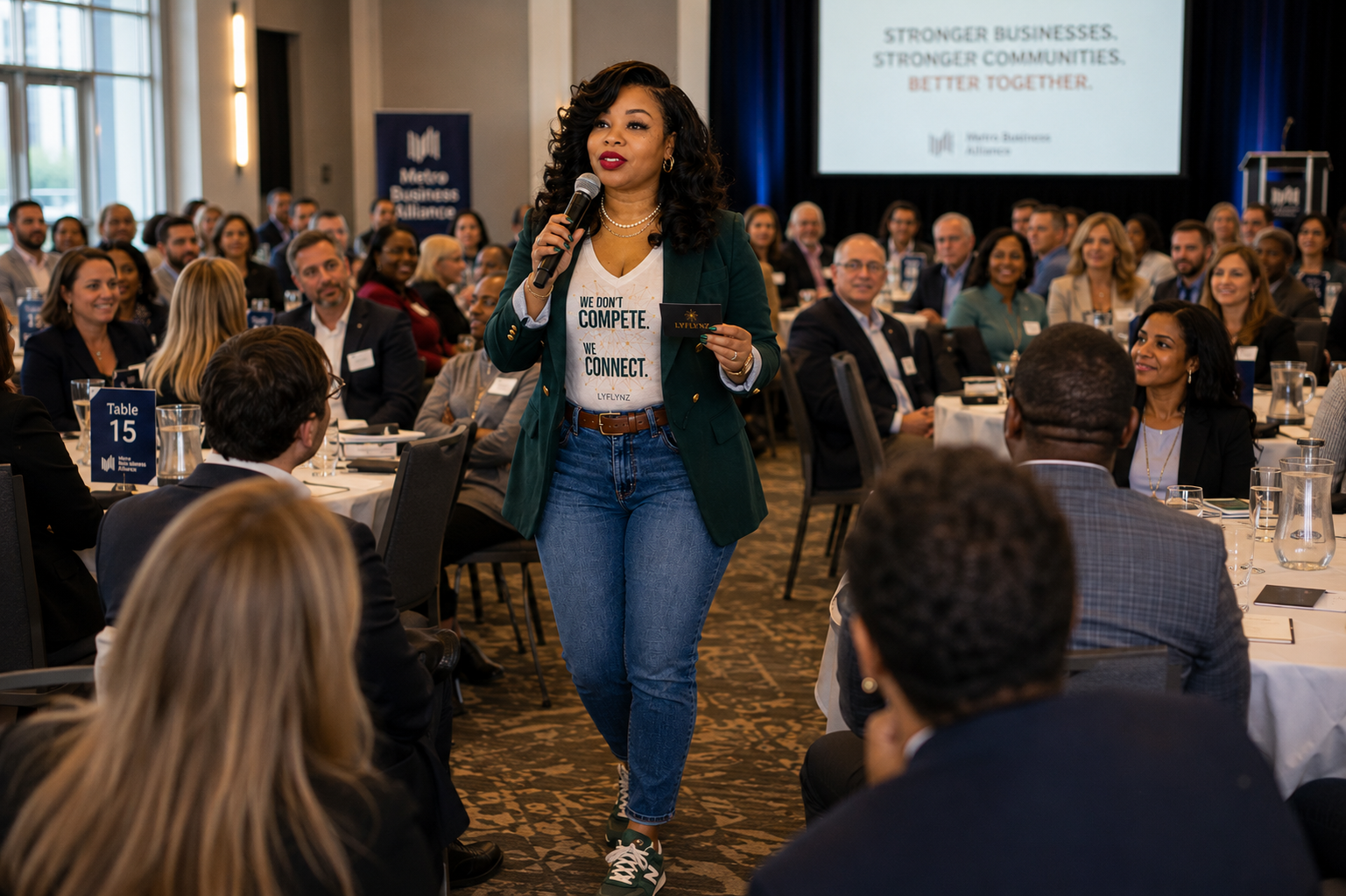
That is the idea behind a phrase we use at Community Growth Partner:
People Are the Algorithm.
It is a metaphor, not a technical claim.
It describes how human relationships influence who gets remembered, mentioned, introduced, recommended, and connected offline.
What gets surfaced?
That is the question algorithms and human networks have in common.
Online, signals may help determine which page, post, business, or piece of information gets surfaced.
In a community, people respond to relational signals.
Those might include:
- Recognition: “I've seen her before.”
- Familiarity: “I know who she is and what company she represents.”
- Conversation: “We've actually talked.”
- Context: “I understand what they do and who they help.”
- Trust: “My experiences with them give me confidence in making this connection.”
- Usefulness: “They've helped people, shared information, or made good introductions.”
- Memory: “When the need appeared, their name came to mind.”
Those signals do not form a rigid funnel.
Someone may make an introduction after one exceptional conversation.
Another person may recognize a representative for months before ever speaking with them.
Someone may never become a customer but may become one of the business's strongest referral relationships.
Human networks are messy.
The point is not the sequence.
The point is that relationships create signals, and those signals affect who gets surfaced.
The human search result
Imagine a local business owner who regularly attends a chamber luncheon.
Over time, she notices the same representative from a company at several gatherings.
They eventually have a meaningful conversation.
At another event, the representative remembers what she does.
Later, he introduces her to someone useful without asking for anything in return.
Months pass.
Then someone in her network asks:
“Do you know anyone who handles that?”
She does.
A name comes to mind.
That moment is the offline equivalent of being surfaced.
The business was not selected because it repeated a keyword enough times.
It was remembered because a human being had enough relational context to connect the business with the need.
Online, an algorithm may determine what gets displayed. Offline, people often determine what gets remembered and recommended.
Presence alone is not the algorithm
This distinction is important.
Simply attending events does not entitle a business to trust, recommendations, or referrals.
A person can attend fifty networking events and leave very little positive impression.
Presence creates opportunity for relationships.
What happens with that opportunity matters.
Do you listen?
Do you remember people?
Do you follow through?
Do you make useful connections?
Do you support the community even when there is nothing immediate to gain?
Do people understand what your business actually does?
Are interactions consistently positive?
People Are the Algorithm is not an argument for visibility at any cost.
It is an argument for relational relevance.
Can businesses buy relational signals?
Businesses can absolutely buy visibility.
They can sponsor events.
Purchase advertisements.
Buy booths.
Fund activations.
Place logos on banners.
Sponsor tables.
Those things can be valuable and can create opportunities for people to encounter the business.
What money cannot guarantee is what happens inside another person's mind afterward.
It cannot purchase genuine familiarity.
It cannot guarantee trust.
It cannot force someone to remember the business at the right moment.
And it cannot manufacture a meaningful relationship simply by increasing impressions.
Paid visibility can help create the encounter.
Relationship quality influences what the encounter becomes.
Human signals travel across rooms
Another important difference between digital and relational networks is that people move.
The person you meet at a chamber luncheon may also sit on a nonprofit board.
The Realtor you meet at a professional breakfast is also a homeowner, parent, neighbor, and community member.
A business owner at a ribbon cutting may belong to three other organizations.
A resident at a festival may run a company you have never heard of.
Relationships do not stay neatly inside B2B and B2C boxes.
People carry information, impressions, introductions, and recommendations with them.
That is one reason local relationship ecosystems can be so powerful.
One good interaction can travel.
Relational signals need context
Being remembered is only useful if someone remembers enough to know why you should come to mind.
That is where relationship intelligence enters the picture.
If someone remembers your face but has no idea what your business does, recognition has limited value.
If a representative knows dozens of people but cannot remember what matters to them, the network loses much of its usefulness.
Relationships become more actionable when context travels with them.
Who is this person?
What matters to them?
What does their business do?
Who would benefit from knowing them?
What did they mention last time?
Is there a reason to reconnect?
That context helps turn recognition into useful connection.
What strengthens human relationship signals?
There is no guaranteed formula, but several behaviors support healthy relational visibility:
- Returning to relevant environments consistently
- Listening more than pitching
- Remembering what matters to people
- Making thoughtful introductions
- Following through on commitments
- Being useful even when no transaction is available
- Participating across both business and community environments
- Allowing relationships to develop at their natural pace
Notice how little of that resembles traditional prospecting.
The objective is not to manipulate people into recommending a business.
It is to participate meaningfully enough that the business becomes understood and remembered.
Where Community Growth Partner fits
Community Growth Partner™ helps partner businesses maintain this kind of relational presence across the communities that matter to them.
A Community Growth Partner enters relevant environments consistently, develops relationships, retains useful context, makes appropriate connections, and carries information forward instead of allowing each interaction to disappear when the event ends.
That fits the broader CGP rhythm:
Presence → Relationships → Intelligence → Action
The goal is not to manufacture recommendations.
It is to strengthen the human relationships and context from which introductions, referrals, partnerships, information, and opportunities can naturally emerge.
You can explore more about Local Business Growth and How It Works, or read The Missing Middle Between Marketing and Sales for the larger business framework surrounding these relationships.
Algorithms will continue determining much of what gets surfaced online.
But when someone turns to another human being and asks—
“Who do you know?”
—people are still the algorithm.