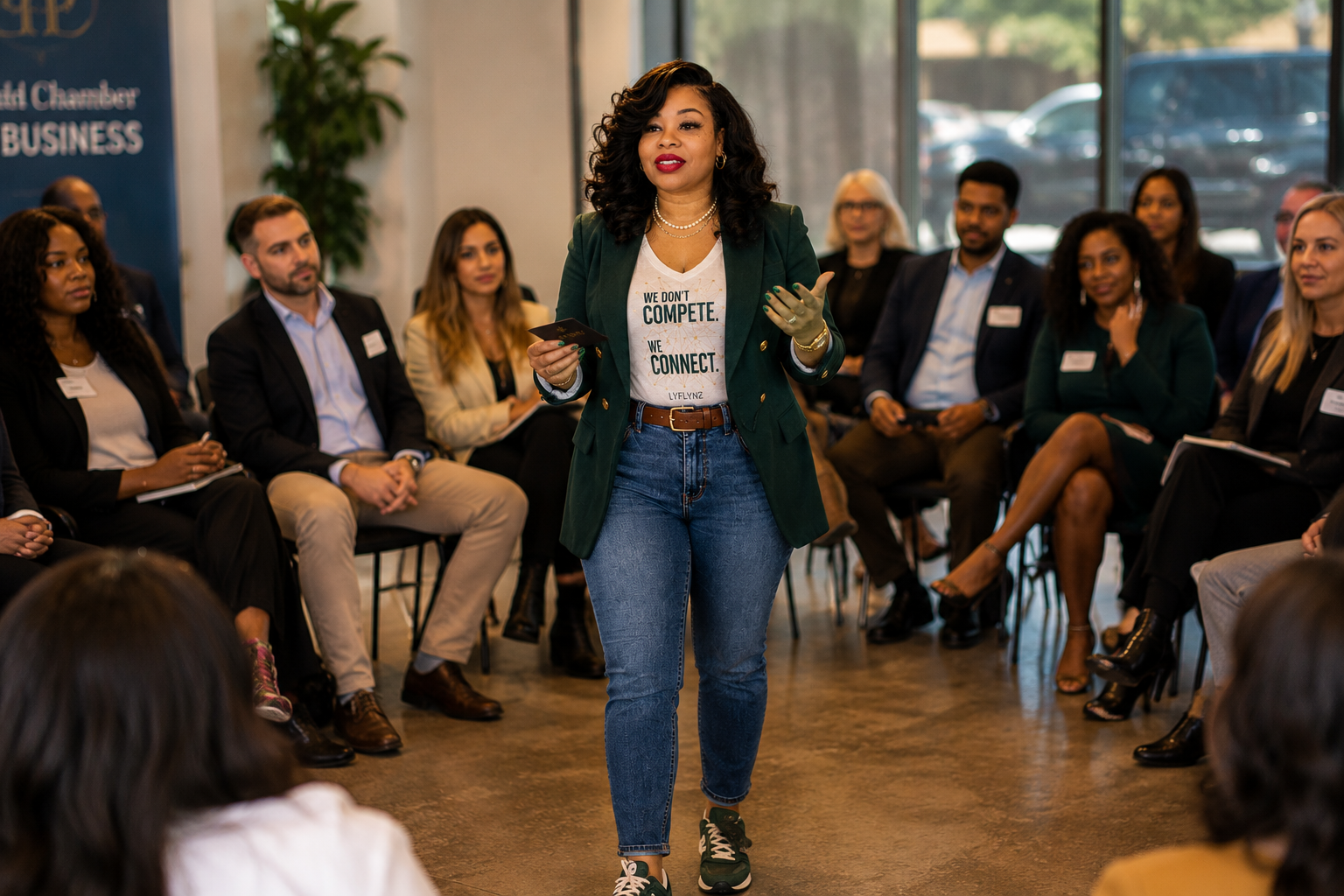
Field marketing is one of the most established ways a business takes its message off the screen and into the physical world. If you have ever sampled a product in a store, visited a branded booth at an expo, attended a promotional activation, or spoken with a company representative at a public event, you have encountered some form of field marketing.
Community representation also puts a person in physical places on a business’s behalf. From across the room, the two can look similar. Both may involve events, conversations, brand knowledge, and face-to-face interaction.
But they are designed to do different jobs.
Understanding that distinction matters, especially for businesses trying to determine whether they need a campaign in the field or a consistent presence within the relationships and communities surrounding their business.
What field marketing usually involves
Field marketing brings marketing activity directly into a market, event, venue, or community. Depending on the business and strategy, that can include:
- Brand activations and experiential events
- Product demonstrations and sampling
- Trade shows and expo booths
- Promotional teams at festivals, stores, or public venues
- Local campaigns supporting a launch or market expansion
- Lead generation and contact capture
- Localized execution of a larger marketing strategy
A home-services company might participate in a spring home show. A franchise may coordinate activities around a grand opening. A company entering a new region might use events and activations to introduce its brand to the market.
Field marketing can create substantial face-to-face visibility and engagement. It can also produce relationships. A conversation that begins at an expo booth may eventually become a customer, referral partner, vendor relationship, or something else entirely.
The distinction is not that field marketing cannot create relationships.
The distinction is what the work is primarily organized to accomplish.
What community representation focuses on
Community representation begins with a different organizing principle: sustained presence.
Instead of asking only, “How do we activate our brand at this event or during this campaign?” community representation asks:
Where do the relationships surrounding this business develop, and who is responsible for being consistently present there?
Those environments may include chambers of commerce, professional associations, networking groups, ribbon cuttings, conferences, expos, festivals, vendor events, community gatherings, social events, and business mixers.
The representative does not simply enter a room, deliver a message, and leave.
They return.
That continuity allows something different to develop. People recognize one another. Conversations resume instead of restarting. Introductions lead to other introductions. A person who mentioned an expansion several months ago can be asked how it is progressing. Someone looking for a particular resource can be connected with someone met in another room.
Over time, individual interactions begin to form a relationship network around the business.
A side-by-side view
| Field marketing | Community representation | |
|---|---|---|
| Common organizing focus | Campaign, activation, market initiative, or field objective | Sustained community presence |
| Time horizon | May be campaign-based or ongoing | Designed around continuity |
| Common goals | Awareness, engagement, activation, leads, market execution | Familiarity, relationships, connection, local context |
| Interaction style | Can range from brief/high-volume to relationship-oriented | Intentionally relationship-centered and recurring |
| What carries forward | Campaign results, contacts, market feedback | Relationships, context, introductions, follow-through |
| Relationship continuity | Varies by program | Central to the model |
Neither approach is inherently better.
A business launching a product may need field marketing. A company exhibiting at a major trade show may need a well-designed activation. A brand entering a new market may benefit from both field marketing and sustained community representation.
The important question is what problem the business is actually trying to solve.
Reach and relationships are not opposites
Community representation does not mean sacrificing reach.
A representative may attend a large expo, conference, festival, or community event and interact with many people. The difference is that the interaction does not necessarily end when the event does.
Someone met at an expo may appear again at a chamber luncheon. A business owner met at a ribbon cutting may later attend an association meeting. A community leader may become a connector to another organization.
The event creates contact.
Continuity gives the contact somewhere to go.
That is one of the central differences between simply appearing in the market and maintaining a presence within it.
Relationship intelligence changes what carries forward
Another important difference is what happens to information learned through those interactions.
A name and email address can tell a business who someone is.
Relationship context can tell the business much more:
What does this person care about? What is happening in their organization? Who are they trying to meet? What did they mention the last time you spoke? Is there an introduction that would be useful? Is there something worth following up on later?
That context is part of what we call relationship intelligence.
When retained thoughtfully, it allows the next interaction to build on the previous one rather than starting over.
The goal is not to turn every person into a prospect. Some relationships become customers. Others become referral partners, collaborators, connectors, resources, sources of local insight, or simply valuable members of the business’s broader community.
Relationships have value before a transaction exists.
Where Community Growth Partner fits
Community Growth Partner™ was built around this sustained form of community representation.
A Community Growth Partner maintains consistent human presence on behalf of multiple non-competing partner businesses across the environments relevant to their growth and relationships.
That distinction matters.
A CGP is not simply an event attendee assigned to distribute materials, nor an employee replacing the owner as the face of the company. The role is to understand the partner business well enough to represent it appropriately while building and maintaining relationships across the community.
The work follows a broader rhythm:
Presence → Relationships → Intelligence → Action
Be present in the right environments.
Develop genuine relationships.
Retain useful relationship context.
Then turn appropriate context into thoughtful follow-through, introductions, connections, and informed action.
That work complements marketing and sales rather than replacing either one.
You can explore the model further on How It Works or see how it supports Local Business Growth.
Which approach does your business need?
A few questions can help clarify the need:
- Are you trying to support a specific campaign, launch, promotion, or activation?
- Does your growth depend heavily on referrals, partnerships, introductions, or local relationships?
- Are important conversations happening in community environments where your business is inconsistently represented?
- What happens to relationships after an event ends?
- Who is responsible for staying connected when there is no immediate sales opportunity?
- Would your business benefit from being consistently represented even when the owner or team cannot attend?
Sometimes the answer will be field marketing.
Sometimes it will be community representation.
And sometimes the strongest strategy will include both.
The important thing is recognizing that being physically present and being relationally present are not always the same job.